Privacy UX · Big Data · Interaction Design
DataMynd: making personal data exchange visible and controllable
DataMynd explores how people could securely store personal data, understand its value and decide when companies, researchers or institutions are allowed to use it. The project turns abstract data flows into visible, understandable decision moments.
The challenge
People generate valuable data through search, social media, connected products and digital services. Yet they often have little understanding of where this data goes, how it is combined or who benefits from it. DataMynd asks what a more user-centered model could look like.
The design challenge was not only to create another privacy tool. It was to make the hidden exchange of personal data visible enough that people could make confident, informed decisions.
Framing the problem
We researched how personal data is collected, brokered and monetized. The work mapped relationships between data collectors, users, brokers and companies to understand where value is created and where control gets lost.
Core question
How might users regain control over personal data while still enabling useful services, research and innovation?
Research insights
Context matters
People evaluate data sharing differently depending on purpose, requester, data type and perceived benefit.
Control is not enough
Users need to understand what is happening before they can feel in control.
Trust is a UX requirement
Security cannot remain an abstract claim. It has to be explained through interaction, language and feedback.
MVP: Data Tinder
To test the core interaction early, we built a Framer prototype called Data Tinder. The MVP reduced the system to one essential decision: a company requests access to data, the user sees who is asking, what is needed, why it is needed, for how long and what they get in return.
Show a request card with the most important facts.
Let users accept, reject or inspect the request.
Observe what information they need before trusting the request.
What testing changed
We used think-aloud sessions to understand how people reason about data requests. The concept felt relevant, but users repeatedly questioned safety, transparency and trust. The prototype also showed that first-level request cards needed a clear path into deeper explanations.
One important hierarchy changed: the purpose of data use became more important than only the identity of the requester.
Trust became the design material. The interface had to explain who wants what, why, for how long and what the user receives in exchange.
Designing the system
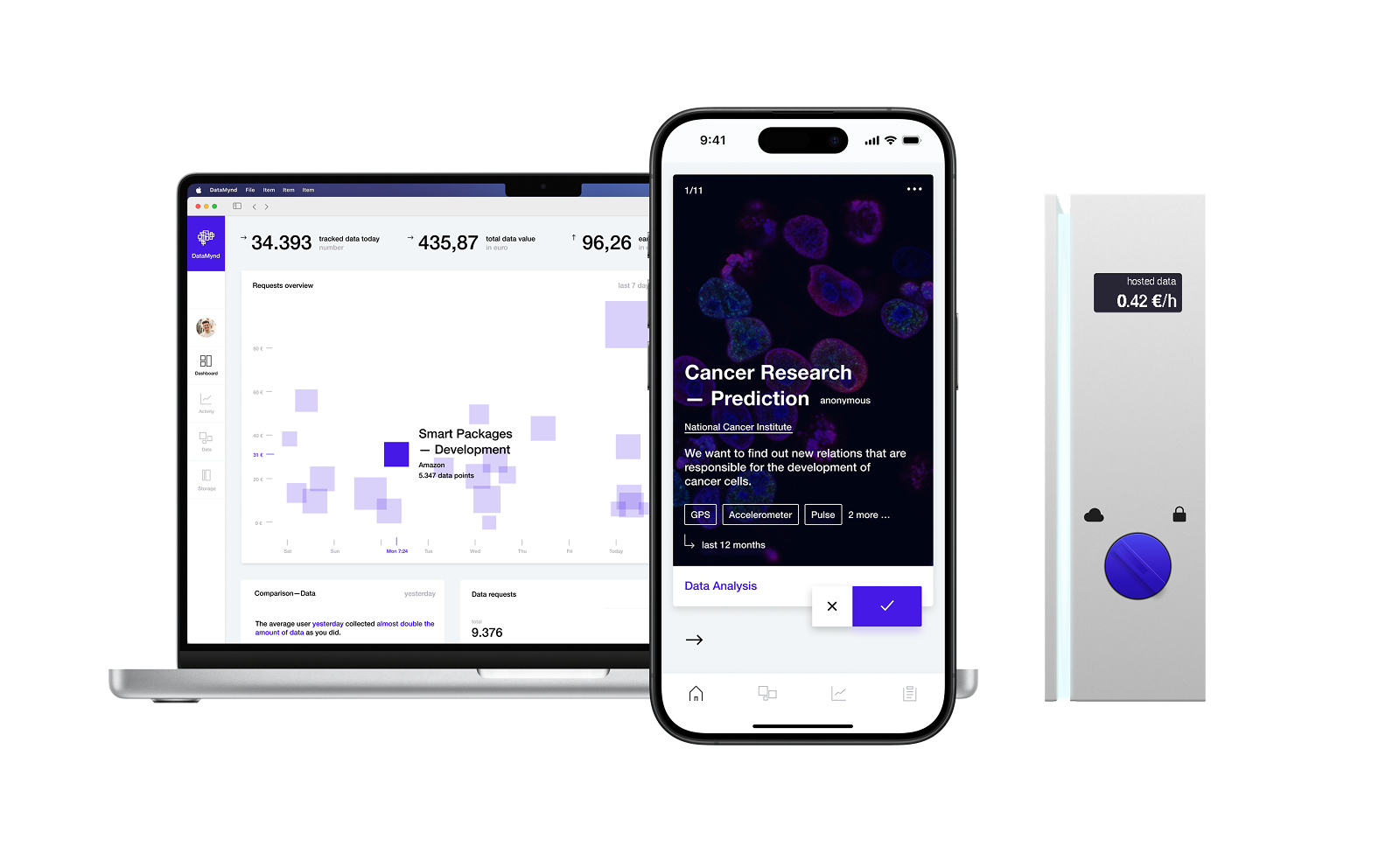
The final direction became a product ecosystem rather than a single app. A personal data system needs more than a permission screen: it needs storage, overview, explanation and an actionable exchange model.
Store
Encrypted decentralized storage gives the system a credible foundation for user ownership.
Understand
A dashboard helps users see what data exists, what it may be worth and where it has been used.
Control
The app turns data requests into transparent decisions instead of hidden background transactions.
Trade or donate
Users can decide whether data access is worth money, analysis, service value or research contribution.
Key product decisions
- Rejected a pure blockchain transaction model because personal data should not simply change owners.
- Moved toward decentralized encrypted storage so users remain holders of the key.
- Designed request cards as first-level decisions, with detail views for purpose, data type and requester context.
- Avoided showing missed earnings for rejected requests because the interface should not punish privacy-conscious decisions.
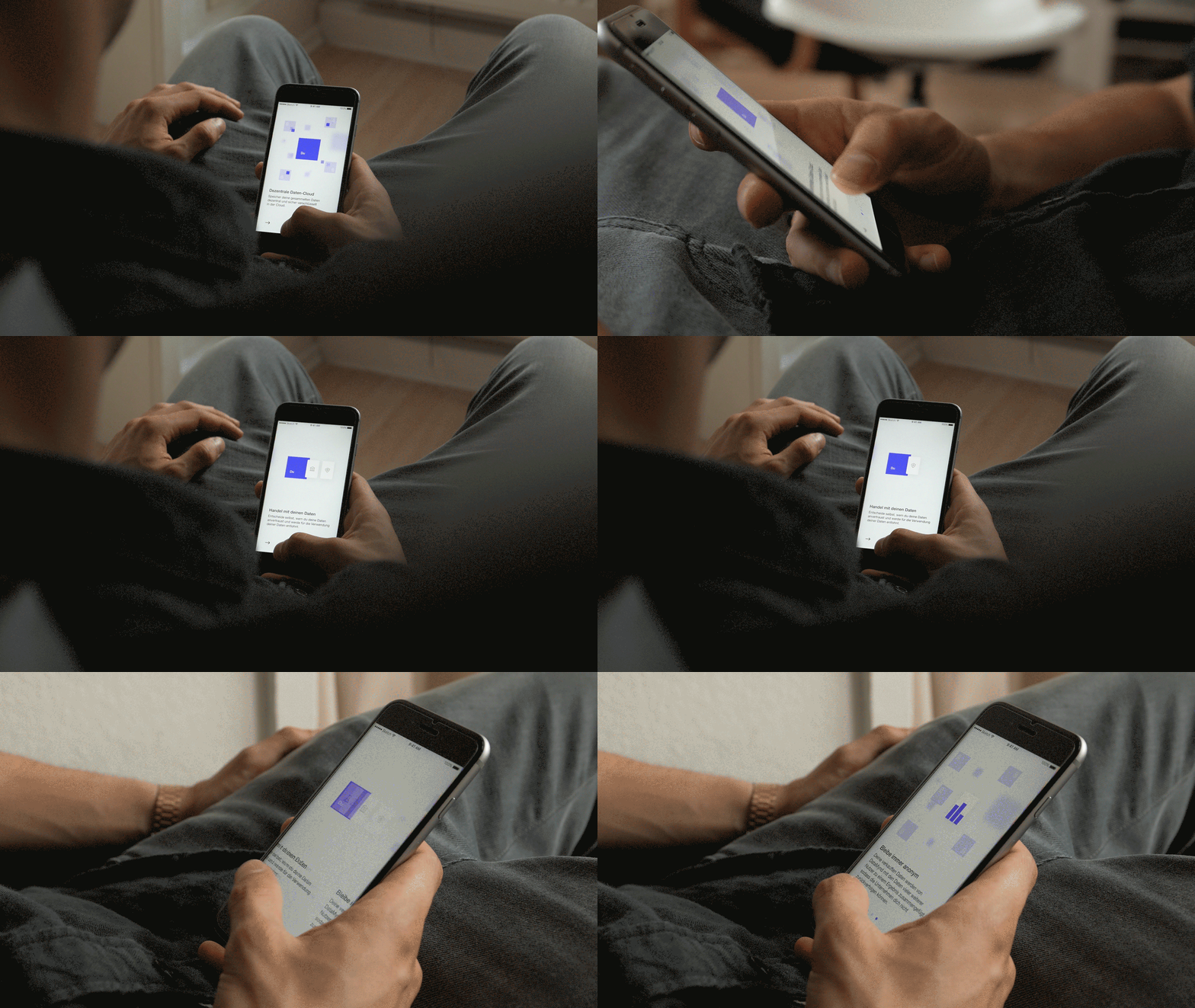
- Used onboarding to explain the path of data through the system and build trust through transparency.
Outcome
DataMynd resulted in a mobile app, a personal data dashboard and a physical storage device. Together they show a future in which users can store data, understand its value and decide which analyses can run on it.
The project demonstrates my ability to turn a complex and technical system into a product story that people can understand and interact with.
What this project says about how I work
I prototype early
The MVP helped test concept relevance before the full system was designed.
I design for trust
The strongest insights came from understanding what users need before they feel safe.
I think in systems
The final solution connects app UX, data infrastructure, dashboards and physical product cues.
Interested in the process behind this project?
I'm happy to share more details about the research, system logic, prototypes and design decisions in an interview.
Get in touch